
Burn Shoulder Rehabilitation: Three Common Home Shoulder Exercises That May Not Be Appropriate

Shiou-Han Yang, Senior Occupational Therapist
Taipei Rehabilitation Center, Sunshine Social Welfare Foundation
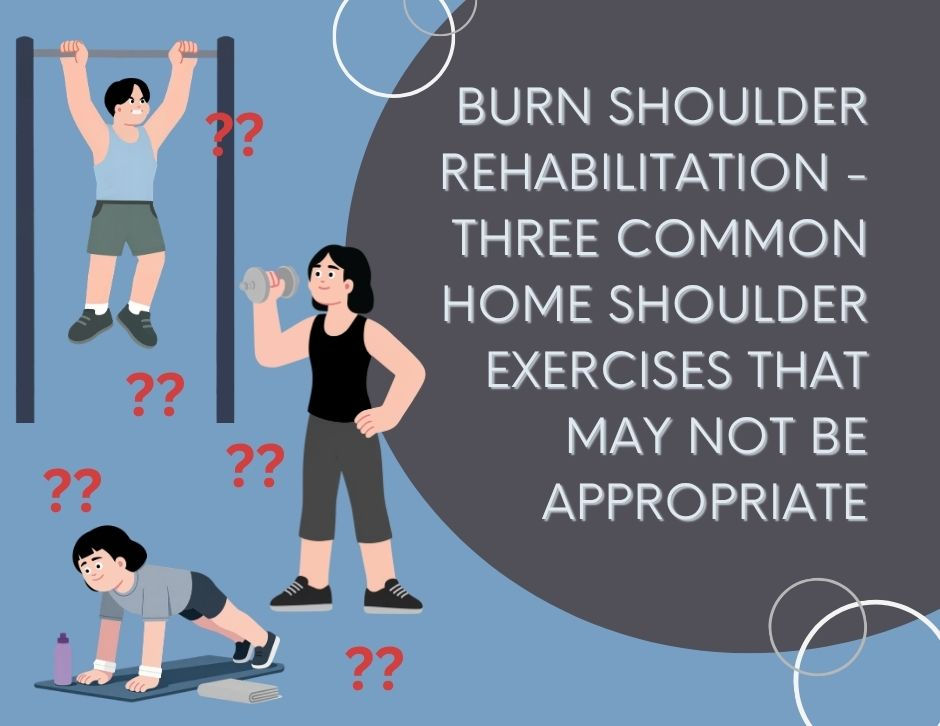
For patients with burn shoulder rehabilitation needs, home exercise programs often play an important role in extending therapy beyond clinical sessions.
Some home exercises originate from therapists' recommendations. However, many patients will choose exercises themselves, based on information found online or suggestions from friends and family. However, when it comes to the shoulder joint, inappropriate exercise choices during periods when scapulohumeral rhythm remains disrupted or compensatory movement patterns are still present may reinforce faulty movement strategies and even interfere with future recovery of shoulder range of motion.
This article reviews three commonly used home exercises that are frequently seen in clinical practice but may not be universally appropriate for burn survivors. We will also discuss the reasons behind these concerns and important considerations for rehabilitation.
Why Are Certain Home Shoulder Exercises Often Preferred in Burn Shoulder Rehabilitation?
1. They Are Easy to Perform
In a home environment, individuals generally prefer exercises that require little preparation and can be performed immediately.
There is nothing inherently wrong with this preference. In fact, simplicity is one reason therapists prescribe home exercise programs. However, when exercises are chosen without proper clinical assessment and clinical reasoning, convenience often comes at the cost of precision. As a result, some muscles may become overused while others continue to receive insufficient training.
2. Physical Effort Is Interpreted as "Effective Feedback"
When exercising independently, many patients naturally judge effectiveness based on sensations such as:
Am I sore?
Am I tired?
Is the movement large and obvious?
As a result, exercises that create a strong sense of effort are more likely to be repeatedly selected, particularly those involving large muscle groups or full-body movements.
In reality, this feedback often reflects general exertion or compensatory effort and is not necessarily indicative of effective rehabilitation. During the early stages of movement retraining, patients frequently need opportunities to focus on activating specific muscle groups. Large-scale exertion may actually reduce awareness of the muscles that should be working.
3. A Natural Extension of Previous Exercise Experience
Previous experiences—whether personal or from others—often influence exercise selection. Examples include:
Strength training habits
Popular exercises found online
Recommendations from friends and family
Because these exercises appear familiar or have been effective in the past, people may assume they will also help their current shoulder condition.
However, every individual has unique physical characteristics. Burn injuries can also create new movement patterns and limitations. An exercise that is beneficial for one person or at one stage of recovery may not be suitable for another person or another phase of rehabilitation.
Three Common Home Exercises That May Not Be Appropriate for Burn Shoulder Rehabilitation
No exercise should be considered universally prohibited. However, the following three exercises are commonly preferred by patients and based on our clinical experience, we found that they are often less suitable for many burn survivors who are attempting to improve shoulder flexion or shoulder abduction.
1. Push-Ups
Common Reasons for Preference
No equipment required
Physically demanding, creating a strong feeling of "I am exercising"
Well-known exercise with which many people are already familiar
Basic Requirements for Performance
Adequate skin stability, especially at the forearms, axilla, and elbows
Normal or at least 50% range of motion across multiple joints, particularly the shoulders, elbows, ankles, and toes
Sufficient stability and motor control across multiple muscle groups, especially the core musculature
Challenges for Burn Survivors
Fragile skin that can easily develop blisters or wounds due to friction and repetitive large-range movements, particularly during the early stages of recovery
Scar continuity that restricts movement across multiple body regions
Muscle weakness, deconditioning, immobilization effects, or compensatory movement patterns that make coordinated activation of multiple muscle groups difficult
Why It’s Not Appropriate/Less Suitable
When shoulder control is not yet well established, push-ups may promote:
Dominance of the pectoral muscles
Increased scapular anterior tilt and protraction
Reduced contribution of normal scapulohumeral rhythm
For this reason, push-ups are generally more appropriate after stable scapular control has been established, shoulder range of motion is nearly restored, and significant compensation or pain is no longer present.
2. Bicep Curls
Common Reasons for Preference
Equipment is easy to obtain
Simple instructions and easy execution
Large visible upper-limb movement that creates a strong sense of exercise
Basic Requirements for Performance
Adequate hand grip function
Sufficient elbow range of motion
Challenges for Burn Survivors
Scar continuity affecting mobility across multiple regions of the upper limb
Why It’s Not Appropriate/Less Suitable
The primary purpose of a bicep curl is to train elbow motion and elbow flexor muscles such as the brachialis and biceps brachii. Its direct influence on shoulder mobility or shoulder abduction and flexion control is relatively limited, making it less suitable as a primary exercise for improving shoulder function.
That said, because:
The fascial system of the upper limb is interconnected,
The biceps brachii crosses multiple joints,
Burn scars often create continuous restrictions across regions, elbow movement can still have indirect positive or negative influence on the shoulder.
When direct shoulder movement is temporarily contraindicated, these indirect influences may help maintain or improve the condition of the surrounding shoulder soft tissues.
3. Hanging from a Pull-Up Bar
Common Reasons for Preference
Simple to perform
Physically demanding, creating a strong feeling of exercise
Familiar exercise with widespread popularity
Basic Requirements for Performance
Adequate grip strength and hand stability
Normal or at least 50% range of motion throughout the upper limb, especially the shoulders, elbows, and fingers
Sufficient stability and control of multiple muscle groups, particularly the back musculature
Challenges for Burn Survivors
Fragile skin that may develop blisters or wounds during repetitive large-range movements, particularly early after injury
Scar continuity restricting mobility across multiple body regions
Insufficient upper-back stability combined with lateral scapular muscle tightness or severe scar contracture may worsen scapulohumeral imbalance, leading to compensatory patterns such as scapular winging or excessive scapular elevation
Increased tension and pain involving the latissimus dorsi, anterior shoulder, and upper limb due to overuse
Why It’s Not Appropriate/Less Suitable
Many individuals assume that hanging from a bar improves shoulder abduction or shoulder flexion because the shoulder appears to be "pulled open" during suspension.
In reality, if the muscles stabilizing the medial border of the scapula are insufficiently active, this gravity-assisted attempt to stretch the axillary region may overstretch scapular stabilizers before the intended soft tissues beneath the arm are adequately lengthened.
Furthermore, during the pulling phase, the exercise may reinforce dominant shoulder adductor activity (note: shoulder adduction, not scapular retraction). In the presence of muscle imbalance, this can contribute to secondary pain and tightness patterns, making the exercise counterproductive for improving shoulder flexion or abduction.
For this reason, hanging exercises are generally more appropriate when stable scapular control, near-complete upper-limb mobility, and minimal compensation or pain have already been achieved.
What Matters Most Is Not Simply Which Exercise You Choose
No exercise can be categorized as simply "good" or "bad."
The same movement may be beneficial during one stage of recovery and problematic during another. Therefore:
Just because an exercise is commonly used does not mean it is appropriate.
Just because an exercise worked in the past does not mean it is suitable now.
The most important questions are not:
Does the exercise look difficult enough?
Does it feel physically demanding?
Instead, we should ask:
Does this exercise match the individual's current functional needs?
Does it help restore healthy scapulohumeral rhythm?
Does it strengthen the specific abilities we are trying to improve?
Knowing which exercises can be performed is important. Equally important is learning how to observe movement quality, identify differences in muscle recruitment patterns, and recognize the gradual development of compensatory strategies within movements that may appear similar on the surface.
This type of observation and analysis extends far beyond the shoulder joint. It represents one of the fundamental principles of burn rehabilitation as a whole. The shoulder is often simply one of the first places where these differences become noticeable.
To learn more about shoulder joint movement abnormalities after burns and scapulohumeral rhythm, check out our series of courses on burned shoulder issues.


Comments